Friday, November 6, 2009

Dia Announces New Space In New York City


The Dia Foundation says it intends to knock down its old building on West 22nd Street and build something new in the same location. Good news from this Chelsea pioneer – Dia moved to the neighborhood in 1986.

More in the Dia press release and a New York Times story.

Pictured is Joseph Beuys' 7000 Oaks on West 22nd Street between 10th and 11th Avenues, New York City.

Wednesday, November 4, 2009

Mat Gleason Coagula Interview Part IV


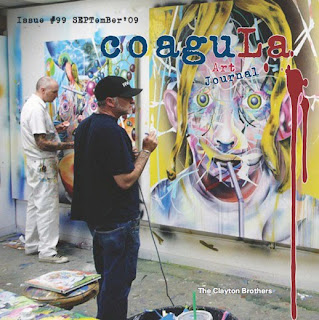
The fourth and final installment of my interview with Mat Gleason, in celebration of Cogaula Art Journal's 100th issue.

(Click here, here and here for Parts I, II and III.)

JW: As a blogger, yourself, what do you think about artists blogging? Do you see any interesting developments in blogging, social networking and other online manifestations of the art world?

MG: Artists blogging can be a good release, a good art form in its own right, but you have to understand that the audience is in charge. Most artists cannot handle that fact. The audience controls the context. The web can make so much art look bland and you might be giving away too much of the product with too many visuals. I hate telling people they have to market, but you are marketing when you are blogging, so the catch-22 becomes that you cannot appear to be "real" if you are stuck on "message" and if you are "real" you can accidentally ruin your "brand" name so to speak. Online is great thought because the art almost ALWAYS looks better in person than it does online. That is not true of print - many artists reproduce well for books and glossy art magazines and in person the stuff underwhelms, but the net, it looks okay on the net and then you see it in person, and it is already familiar, and it is like WOW THIS IS EVEN BETTER IN PERSON almost all the time. So that helps.

JW: With 100 issues under your belt, where do you plan to go from here, both with Coagula and your other projects? Anything new we should be looking out for?

MG: In 2010 we are going to start publishing artist editions on one artist per issue of the magazine, so if you buy the online print-on-demand copy of the magazine you will be able to send in for an edition by the artist. That is the next big step for the magazine. I am already working on Issue 101 with this. But if it flops, fuck it, I will still be publishing six times a year, I learned that the first thing the art world sees you do, they will always have you in that box, so if you are known as a teacher, you are fucked if you want to be anything else, so just go be the best teacher, if you are a crazy cokehead, 30 years later you can be sober 25 years and the art world will still be "watch out, he's a cokehead," so I have worn a lot of hats - curated, gallery owner, yapping on TV about art - but I know that the hat the art world expects me to wear is the first one I wore, I'm the magazine editor who speaks his mind, so that is where I go, where I am at, because it takes me places I haven't yet been! Woo HOO!!!!

Issue #100 of Coagula Art Journal will be viewable November 10, online at Coagula.net.

Mat Gleason image via re-title.com.

Hermitage Bookshop Opens in Brooklyn


The Hermitage, formerly in Beacon, New York, has relocated to Brooklyn. The opening reception is this Saturday, November 7, 6-9pm. There will be a "surprise" film screening at some point in the evening.

35 Meadow Street, Suite 307
Brooklyn, NY 11206

347-422-0395

I will be posting an interview with proprietor Jon Beacham, soon.

Tuesday, November 3, 2009

Mat Gleason Coagula Interview Part III


Continuing a four part interview with Mat Gleason of Coagula Art Journal.

(Click here and here for Parts I and II.)

JW: You've talked before about the importance of urgency and real need in art making. Do you find extremes generally more relevant than subtleties in art and art criticism?

MG: Art can be subtle or not, I don't have a litmus there, but if art criticism is not urgent it makes no impact. It makes hardly any impact anyway, so if it is not raging proclamations, soundbites or screeds of passion the only hope you have got is to get tenure because you were writing about what the department chair wanted to read.

JW: Do you have a favorite Coagula piece or quote from the first 100 issues?

MG: When I go back and read things, sometimes they were written so urgently that they could use a little refining. Off the top of my head the whole Barbara Kruger Issue sticks out as what this whole publication really was and still kind of is... So it is 2000, the fall, Issue #42, there is a great piece on Tom Sachs in this issue. I thought I had a picture of Tom that Ray Newton had taken somewhere. Suddenly it was deadline and the picture had not materialized. I was in a panic and thought I should just go see the MOCA retrospective of Barbara Kruger on Sunday - it had opened on Saturday but I was working on the magazine so I didn't go to the big party, so I decided to go see it Sunday and write a generic review Sunday night, do the layout and pick up a press photo of her on Monday on the way to the printers. Well… the show stunk, it was offensively fascistic, I was enraged at the whole exhibit's evil tone. I came back to my computer and trashed it and found a picture of a poodle on Google image search, which I had just discovered a few weeks before, and made the cover that reads in Barbara Kruger red blocks and text... "KRUGER: YOU CAN'T TEACH AN OLD DOG TO STOP MAKING BAD ART." with a poodle in the background because of Barbara Kruger's notoriously poodle-like haircut. So I still made the printers on Monday, and it was awesome to be in charge of the whole thing enough that it had that flexibility to go from assuming I would like something and write a piece to changing the whole thing and, well I got a lot of feedback on that cover and the article, the whole thing was popular.

JW: Over the course of its seventeen years in print, Coagula has undoubtedly stirred things up from time-to-time. Do you think your work there has made an important contribution to the art world and influenced artists and others, for better or worse, along the way?

MG: When a writer challenges things, the problem becomes NOT taking credit for it. I talked shit about people, like Jeremy Strick at MOCA, and nobody thanked me when he was railroaded out of there years later after he had bled the place dry. Meanwhile Christopher Knight of the LA Times, who was complicit in MOCA's demise in that it happened on his watch as the voice of visual art at the big daily, well he got to mother-hen the rebuilding process in print and look like a civic-minded hero. So yeah, if I told you of my triumphs it would be such a tragedy.

To be continued.

Tomorrow, in the fourth and final installment of our interview, Mat talks about artists who blog and the tyranny of the audience, the dangers of being "real," and what's next for Coagula.

Issue #100 of Coagula Art Journal will be viewable November 10, online at Coagula.net.

Barbara Kruger image via the Brooklyn Museum.

Monday, November 2, 2009

Mat Gleason Coagula Interview Part II


Continuing a four part interview with Mat Gleason of Coagula Art Journal.

(Click here for Part One.)

JW: You've said in the past that artists often don't understand their own work until years after the fact. At best, then, an artist's statement is a curious artifact of self-delusion. That's fine with me, as I've never liked the damned things. But do you think your assessment is in conflict with the conventional wisdom that artists should know what their work is about and communicate that meaning clearly in each piece?

MG: You are really hitting my hot-button issues. Here is what they will never tell you in art school: IF you tell a curator what your work means and they want it to mean something else, you just art statemented yourself out of a show. Curators and collectors and critics and gallery people, most of these folks are smart. Someone told me about a famous artist whose secret to success was letting people at openings finish his thoughts as he started discussing his work and then agreeing with them.

JW: To follow up, do you see it as a copout when an artist makes work that is open to interpretation, oblique, mysterious or mystical?

MG: Absolutely, and that is the flip side of the coin. I operate at the extremes, so the extreme pinhead is to be avoided in his desire to control the context of his work, but just as fiercely we have to call the bullshitters out when they walk into the art world and say that their splash of acrylic shit represents eternity. And it is harder to critique these self-anointed mystics, inscrutable conceptualists and "beauty" adherents than those with a solid game plan that is pompous. The pomposity of the vague and aloof is a tougher con to "out"" in my business. Luckily, it has a trend cycle that we are kind of far from at the moment, so there is less of that going on.

JW: To paraphrase a line in Baudelaire's "Hymn to Beauty," "Beauty rules everything, yet remains unanswerable." Do you have your own definition of beauty and do you believe that beauty is important in art?

MG: I got a better line from a better poet as a retort: "With the lights out, it's less dangerous."Seriously, the lesson to be learned over the next 10 years is how not to be seduced. Look at all the propaganda about beauty in art... Dave Hickey is 70, this art world movement championing beauty is the visual manifestation of an atheist flower-power aesthetic toking its final joint. With that said, I am interested in raw beauty, which is my aesthetic as a punk rock fossil, but as a springboard from which to create something, not an end in itself.

To be continued.

Tomorrow, in Part Three, Mat explains why "screeds of passion" and "raging proclamations" work for him, takes us behind the scenes of Coagula's hottest story ever, and observes that telling it like it is doesn't win medals.

Issue #100 of Coagula Art Journal will be viewable November 10, online at Coagula.net.

Rothko Chapel photo via Houston Press.

James Westwater at Heidi Cho


Just got word the show at Heidi Cho Gallery will be up for a couple more days than advertised – through November 14. Thanks to Amanda A. for this pic (detail) of the 1995-2009 installation "Noisy Lawnmower – Sweet Music" (and yours truly, James Westwater) at the opening.

Sunday, November 1, 2009

Issue #100 Interview with Coagula's Mat Gleason


To help celebrate the 100th issue of Coagula Art Journal, I was invited to talk to publisher/editor/founder Mat Gleason about his art criticism and ideas.

Mat practices a bare knuckle critical style, sometimes reminiscent of his fellow westerners, Dave Hickey and Zane Fischer, and Robert Hughes at his most pugilistic. What he might lack in heavyweight credentials, he more than makes up for with some nifty footwork, a heart-on-sleeve doggedness and the occasional swift left jab.

The interview was conducted October 27-30, 2009, via email between my studio in Beacon, New York and Mat's Los Angeles base, and will be serialized in four parts over the next few days.

JW: You have a reputation as an art world maverick. Specifically, I've heard you say that in Los Angeles artists like you and galleries and institutions don't, and that that's reversed in New York. Could you shed some light on this phenomenon and would you say it has changed at all in your seventeen years publishing Coagula?

MG: It used to be primarily in New York that the artists would have a "Don't Rock The Boat" attitude, now that is in a lot of places. There is an attitude of artists that they are learning the ropes and are waiting in line for their turn and that any truly disruptive force to the art world is a threat to their investment of time into playing the game. Meanwhile the people at the top, they were not going anywhere so they loved a little challenge to the status quo, but nowadays they are way more uptight. What has happened is that there are actually fewer truly rich people at the top of the art world, so you have a whole group of people whose true power, their wealth, can be affected by getting fired from a museum job. So what HAS changed is that more people are in the art world to work and earn a living rather than to have fun and that makes any rabble rousing really frowned upon.

JW: What sort of relationship do you have with other art critics and with art criticism in general? Peter Schjeldahl once said to me, "Writing a check is very much more sincere than writing a review ...because it hurts ...you've got to mean it." Do you agree?

MG: We are all kind of scraping for the same crumbs so it is not generally a chummy lot - Since I created my vehicle and own it I am not in the "socialize to get gigs mode" that so many others are in. Sad fact is it doesn't pay that much, the gigs are few and far between and there are a lot of gray areas of morality about taking money to write catalogue essays, et cetera, and then add academia which is totally corrupt with helping colleagues who can get you tenure, and then add writers curating shows and having a back door to art world power and... I just stay the fuck out of other writer's business and keep my nose clean. Collectors are often way more passionate than critics, there is a jaded quality after you realize that even if you got hired by Art Forum, at the 20-year high school reunion you won't be as popular as the guy who runs an antique shop.

JW: I've heard you say that much so-called art is really craft, and that much art is just commerce or industry in disguise. Would you make a similar distinction between art and design, and do you see this and other boundaries blurring?

MG: Design is a sizzling trend at the moment and the hot core of this idea is that it can be as much a piece of fine art as anything else. And I reject that completely. Design, the idea of purity and an artwork being pure design, that is not where I am at in appreciating the effort of an artist. And design is so trendy, ephemeral and like a fashion that dates you if you wear it three years late. I like art that elevates a person's consciousness and design is wallpaper, and wallpaper elevates a room's consciousness at best.

To be continued.

Tomorrow, in Part Two, Mat reveals how artists can best describe their work, gets down and dirty about mysterious and mystical art, and goes for the jugular on the subject of beauty.

Issue #100 of Coagula Art Journal will be viewable November 10, online at Coagula.net.